

CNE has been analyzing the six critical large-scale efforts that are currently underway in the energy sector. Our team of experts is uniquely positioned to view these efforts as part of a comprehensive whole, recognizing the interconnectedness of each project and their collective impact on Puerto Rico’s energy future.
Energy
Years of experience have positioned CNE as a leading authority in this complex and ever-evolving sector. Puerto Rico’s energy landscape is like an intricate puzzle—complicated and multifaceted, with moving pieces that must fit together to achieve a sustainable, affordable, and reliable system.
A Complex Landscape
Keep scrolling or click on the titles below for a look at each of the following pieces of the puzzle:
- Large Cast of Players
- Operational Restructuring (LUMA & Genera Agreements)
- Transition to 100% Renewable Generation
- Short-Term Stabilization of the System
- Permanent Work to Rebuild Damage from Hurricane María
- New Integrated Resource Plan
- Financial Restructuring in Federal Court

With so many players in the field, the local energy sector is far more convoluted than when the Puerto Rico Electric Power Authority was the sole entity in charge.
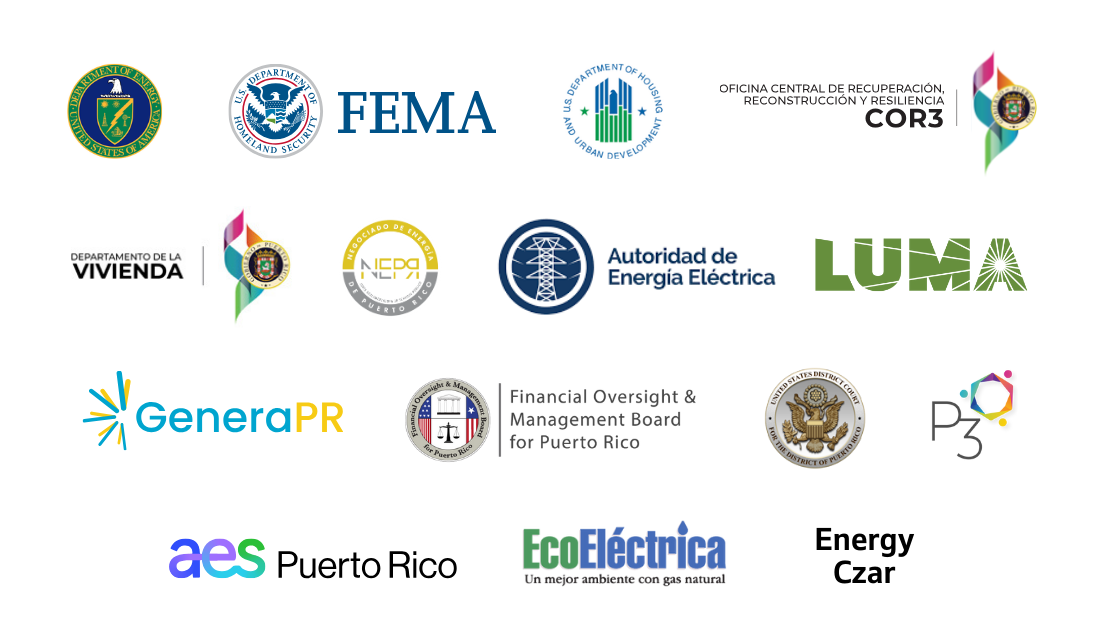
In addition to the 14 organizations shown above, dozens of consultants, suppliers, rooftop solar systems vendors, investors and developers of utility-scale renewable generation sites, trade organizations, NGOs, and other community-based organizations are involved in the transformation of Puerto Rico’s energy sector.
Click the dropdown button below to understand the roles each of these organizations play.
The U.S. Department of Energy (“DOE”) – Carried out the PR100 Study and was also allocated $1 billion by Congress to finance distributed energy projects at the community level in Puerto Rico.
Federal Emergency Management Agency (“FEMA”) – Administers and oversees the use of $13.7 billion allocated to rebuild the electric grid.
The U.S. Department of Housing and Urban Development (“HUD”) – Is in charge of administering approximately $1.9 billion in CDBG funds to upgrade Puerto Rico’s energy system.
Central Office for Recovery, Reconstruction, and Resiliency (“COR3”) – The main liaison between the government of Puerto Rico and FEMA. The COR3 is technically the grantee for most federal reconstruction funding.
Puerto Rico Department of Housing (“DOH”) – Administers and oversees the use of CDBG funds in Puerto Rico.
Puerto Rico Energy Bureau (“PREB”) – The independent regulator of Puerto Rico’s electric system. It has a statutory mandate to regulate the generation and sale of electricity in the island; to set rates; and to plan for the efficient long-term operation of the electric system, among other important matters.
Puerto Rico Electric Power Authority (“PREPA”) – Puerto Rico’s legacy utility, currently in bankruptcy and the nominal owner of the assets of Puerto Rico’s electric system.
LUMA – Private manager and operator of Puerto Rico’s electric grid. In charge of authorizing interconnections to the grid and dispatching electricity.
Genera – Private manager and operator of PREPA’s legacy generation assets. In charge of decommissioning existing fossil-fuel generation and coordinating the ramp-up of new renewable generation resources.
AES and Ecoeléctrica – Independent power producers with an aggregate generation capacity of approximately 900 MW using coal and natural gas, respectively. The AES plant is statutorily required to be shut down in 2028.
Public Private Partnership Administration (“P3A”) – Executes limited oversight functions pursuant to the operation and management agreements executed with each LUMA and Genera, respectively.
Fiscal Oversight and Management Board (“FOMB”) – Represents PREPA in its bankruptcy process. Has oversight powers over PREPA pursuant to PROMESA. Certifies PREPA’s annual Fiscal Plan and its operating budget. Exercises authority under PROMESA to review certain contracts covered by that law. In the case of PREPA, it has been in charge of reviewing the terms and conditions of the power purchase agreements between developers of utility-scale renewable generation and PREPA.
The United States District Court for the District of Puerto Rico (“Federal Court”) – Has jurisdiction over PREPA’s bankruptcy under Title III of PROMESA. It will eventually determine how much PREPA’s creditors can recover from the bankrupt utility and certify a Plan of Adjustment (“POA”). The POA will affect electricity rates in so far as it provides for the imposition of a special charge to repay bondholders and PREPA is otherwise unable to generate offsetting cost savings.